
2026 Conference
CDFIs at Work: Bridging the Gap
March 23-24, 2026 in Albany

CDFI Coalition leadership at the conference included (from left, rear): Lloyd Doaman, Harlem Entrepreneurial Fund; Dan Fielding, Habitat NYC Community Fund; Charlie Hammerman, The Disability Opportunity Fund; Kevin Mietlicki, Alternatives Federal Credit Union; Colleen Ryan, Consulting Executive Director, NYS CDFI Coalition; Robert Benitez, Community Capital NY; Javier Zapata, Enterprise Center at PathStone; Melanie Stern, SpringBank; Tyra Johnson Hux, LISC; Dorian Wells, Community Loan Fund of the Capital Region. (From left, front) Jessie Lee, Renaissance; Giovana Bracchi, La Fuerza; Nancy Carin, Business Outreach Center Network; Aisha Benson, NFF; MaryAnn Lunetta, Center for NYC Neighborhoods; Yanki Tshering, Accompany Capital.
2026 Conference Highlights
CDFIs at Work: Bridging the Gap
“It is powerful to be in a room like this. A room of people who don’t just talk about change, but who wake up every morning thinking about it… planning it… financing it… structuring it… and fighting for it every single day.”
Welcoming remarks from Aisha Benson, the Chair of the Coalition’s Board of Directors, set the tone for more than 100 practitioners and mission-aligned allies — the "mighty 100" — representing a far larger network driving community change.
She called out the persistent gaps CDFIs work to close: capital, skills, and trust — all made more urgent by today's climate of economic uncertainty and growing community need. Framing this moment as a season demanding creativity, collaboration, and courage, she challenged attendees to pool capital, build platforms over programs, and move from participants in systems to architects of new ones. Her closing challenge to attendees: leave informed, equipped, and ready to build together.
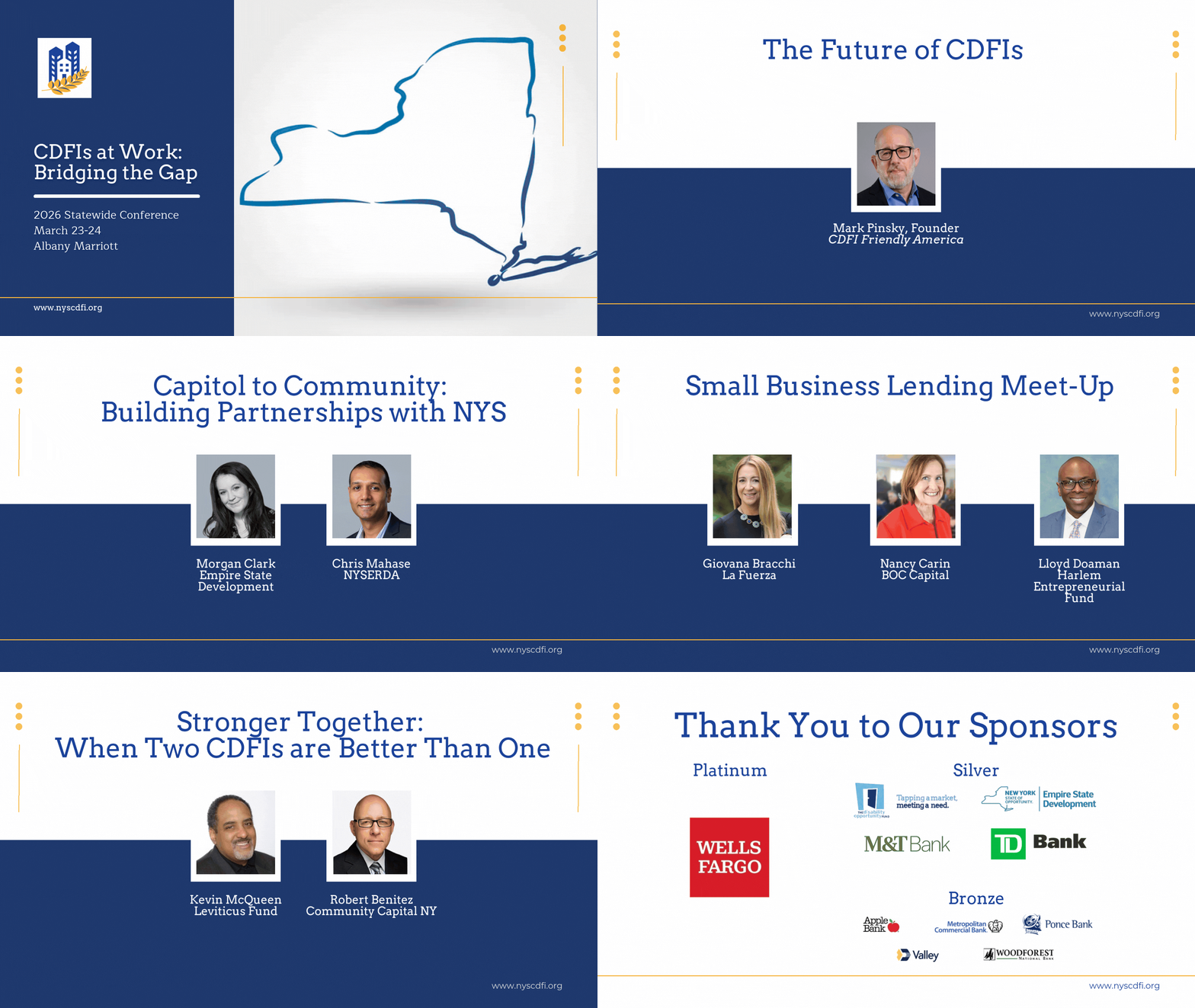
The Plenary Session, titled The Future of CDFIs, delivered a frank assessment of the CDFI movement’s trajectory, examining the tension between transformation and transaction, the strength to be found in coalitions, and leadership succession. Mark Pinsky, founder of CDFI Friendly America with more than 30 years of experience, challenged practitioners to speak uncomfortable truths while sustaining the mission-driven roots that define community finance. Attendees responded enthusiastically to his presentation, especially his ability to balance pragmatism with optimism.
The Lunch Panel, Unlocking Private Capital to Deliver Impact, was presented by Amir Ali, CFA, founder of Clarity Impact Finance, and Sabrina Stratton from Amalgamated Bank. With federal funding under pressure, CDFIs must hone their skills for raising private capital. The candid, both-sides-of-the-table conversation covered what banks look for, common pitfalls, and practical strategies for building lasting investor relationships. A post-session survey response noted that “Amir and Sabrina were a dynamic duo. Their session was very informative with clear take-aways and next steps.”
Session I, Capitol to Community: Building Partnerships with NYS, offered insight on working with two state agencies – Empire State Development and NYS Energy & Research Development Authority. Morgan Clark of ESD and Chris Mahase of NYSERDA outlined existing and upcoming opportunities for CDFIs to access capital, expand lending, and advance clean energy in underserved communities. A lively question and answer session touched on partnership on-ramps, contractor network gaps, a call to share impact metrics, and techniques for putting New York State resources to work at the local level.
Session II, Driving Change: How Cross-Sector Partnerships Help Build Resilient Communities, explored how an unlikely coalition – taxi worker advocates, several CDFIs, and state and city government – delivered ultra-low-interest loans to help NYC Taxi owner-operators get out of debt and purchase wheelchair-accessible vehicles. Moderated by Steve Garibell of TD Bank, the panel featured Bhairavi Desai of the NY Taxi Workers Alliance; Yanki Tshering of Accompany Capital; Genny Kurzweil of the Disability Opportunity Fund and Ray Salaberrios of Empire State Development.
Back by popular demand, the Small Business Lending Meet Up highlighted that New York State runs on small businesses – with nearly 4 million jobs built on the ambition of entrepreneurs across every borough and county. CDFI Coalition Board members moderated the discussion, including Lloyd Doaman of Harlem Entrepreneurial Fund, Giovana Bracchi of La Fuerza, and Nancy Carin of BOC Network. Members shared thoughts and questions on how CDFIs can continue to offer safe ways for New York’s entrepreneurs to build and grow their businesses. An attendee noted that the session offered opened doors to “connect with other CDFI's for potential partnership opportunities.”
The Keynote Presentation, Roots & Reckoning: A Candid Conversation on the Past, Present, and Future of Community Finance, welcomed two of the most thoughtful and experienced voices in the community development finance world — Cliff Rosenthal and Mark Pinsky.
A 40-year veteran of the cooperative and community finance movement, Cliff Rosenthal founded the NYS CDFI Coalition in 1995, led the National Federation of Community Development Credit Unions (now Inclusiv) for many years, and established the Office of Financial Empowerment at the federal Consumer Financial Protection Bureau in 2012. He is widely recognized as a leading voice for credit unions and financial inclusion.
Mark Pinsky is the founder of CDFI Friendly America and former 21-year CEO of Opportunity Finance Network, where he helped grow CDFIs into a recognized force in American finance. He has more than three decades of leadership in building and scaling the CDFI industry.
From its grassroots origins to its multibillion-dollar present, they examined pivotal milestones, the fight for economic equity, and the movement's future despite an uncertain federal policy landscape. The conversation was recorded and will be available on YouTube (link coming soon).
Following a question-and-answer session, attendees enjoyed a reception and book signing for Cliff’s latest book, Community Development Finance: COVID, George Floyd, and the Fight for Equity, 2016-2025 (FriesenPress 2026). The book is the third in his trilogy on the CDFI movement, along with Democratizing Finance: Origins of the Community Development Financial Institutions Movement (2018) and Community Capital: Race, Equity, and the Credit Union Movement (2024).
The second day of the conference opened with breakfast networking, followed by Session III titled Stronger Together: When Two (or more!) CDFIs Are Better Than One. Kevin McQueen of the Leviticus Fund and Robert Benitez of Community Capital New York showed that when a borrower's financing needs exceed a single CDFI's capacity, participation lending provides a collaborative solution. They shared real transactions to explore co-lending structures, agreement design, and cross-institutional trust-building. During the Q&A, Coalition members expressed interest in a Participation Exchange where CDFI lenders in New York State could post loans that needed additional financial participants. Stay tuned for more information.
Despite Federal Home Loan Bank advances generating up to $97.3 billion in additional annual lending, fewer than 70 of 600+ eligible non-depository CDFIs have joined the system. Session IV, titled Opening Doors: Working with the Federal Home Loan Bank, featured Michael Beifeld and Tom Settino of FHLB New York, who showed how FHLB membership gives CDFIs access to stable, low-cost liquidity that expands counter-cyclically – enabling mission continuity precisely when communities need it most. More than one session attendee noted that they will be exploring ways to leverage this underutilized liquidity tool.
As the conference wrapped up, attendees grabbed box lunches and fanned out across New York State and beyond. They also took with them conversations that happened in the hallway, during breakfast, at the reception, or something they heard in a presentation. The creativity, the hard-won lessons, and the institutional knowledge the conference brings together is extraordinary.
As Colleen Ryan, the consulting Executive Director of the Coalition said, “You came here – to Albany – in mud season – because you believe our communities deserve more. So let’s get to work.”
You are welcome to use any photos from the event on any platform. Please credit Joan Heffler Photography.
View Selected Slideshows
Stronger Together: When Two CDFIs Are Better than One
Opening Doors: Working with the Federal Home Loan Bank
Driving Change: How Cross-Sector Partnerships Help Build Resilient Communities
Capitol to Community: Building Partnerships with NYS - Empire State Development
Capitol to Community: Building Partnerships with NYS - NYSERDA
Sponsors
Thank you to our sponsors for their support, direct and indirect, that helps keep this conference affordable and ensures that our programming reaches a wide audience.
Platinum

Silver


Bronze


